The intelligence layer for your research library.
Turn your papers into structured knowledge.
How it works
Drop PDFs, paste DOIs, or import a BibTeX file from any reference manager.
Metadata, citations, topics, and semantic embeddings are built automatically in the background.
Semantic search, citation graphs, gap analysis — your library, intelligent.
What Athena does
Most of your papers are sitting unread, unconnected, unfindable. Athena builds the metadata, citations, and semantic connections automatically — so your library becomes something you can think with.
Drop a PDF or paste a DOI. Athena does the rest — metadata, full text, topics, collections. Your library builds itself.
Search by meaning, not just keywords. Find papers about an idea even when those exact words never appear in the text.
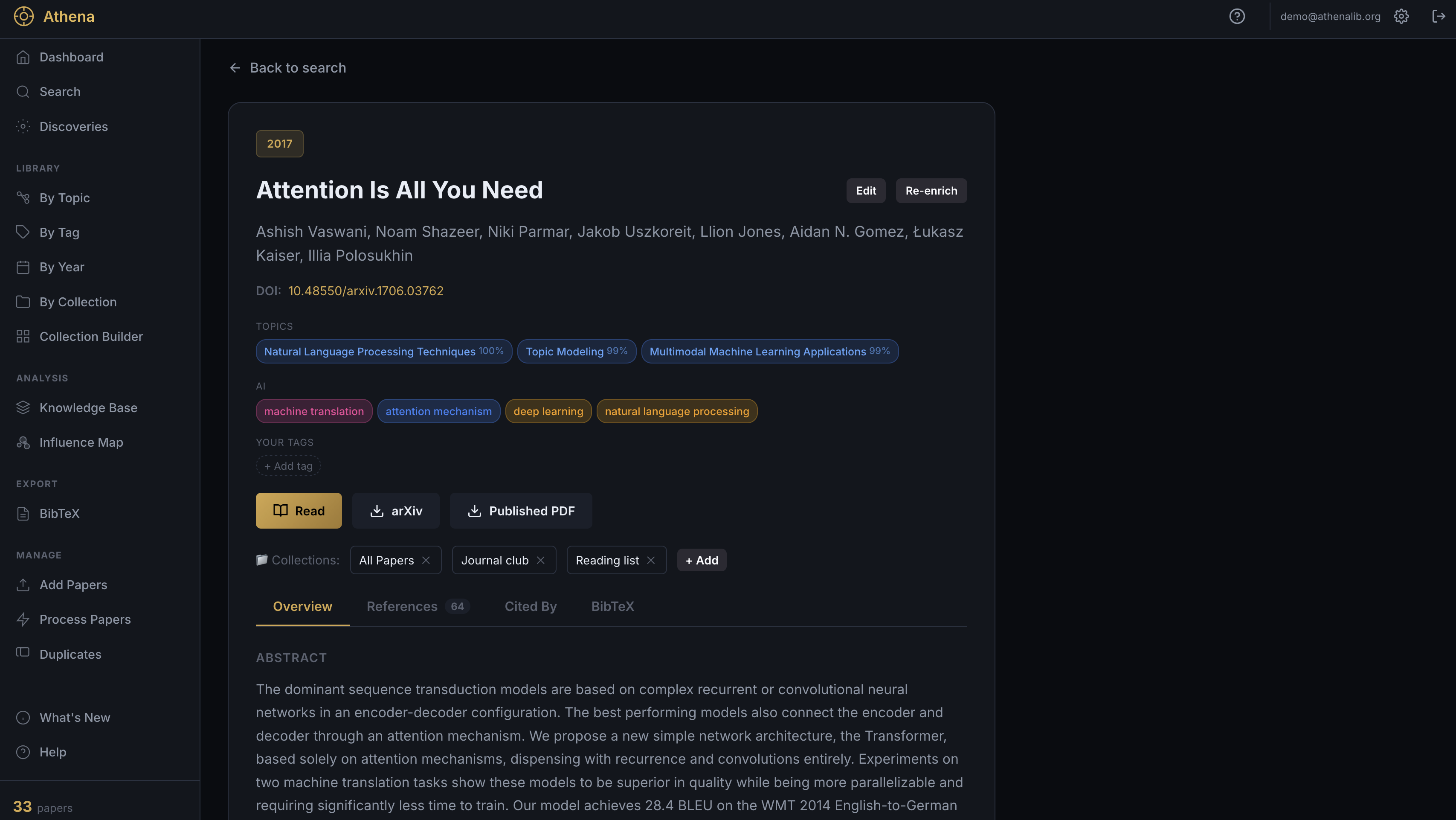
Every paper gets enriched automatically — citations filled, references matched, topics tagged. What would take you hours happens in seconds.
What makes Athena different
Not another bookmark manager. Athena processes your papers the way you would if you had the time.
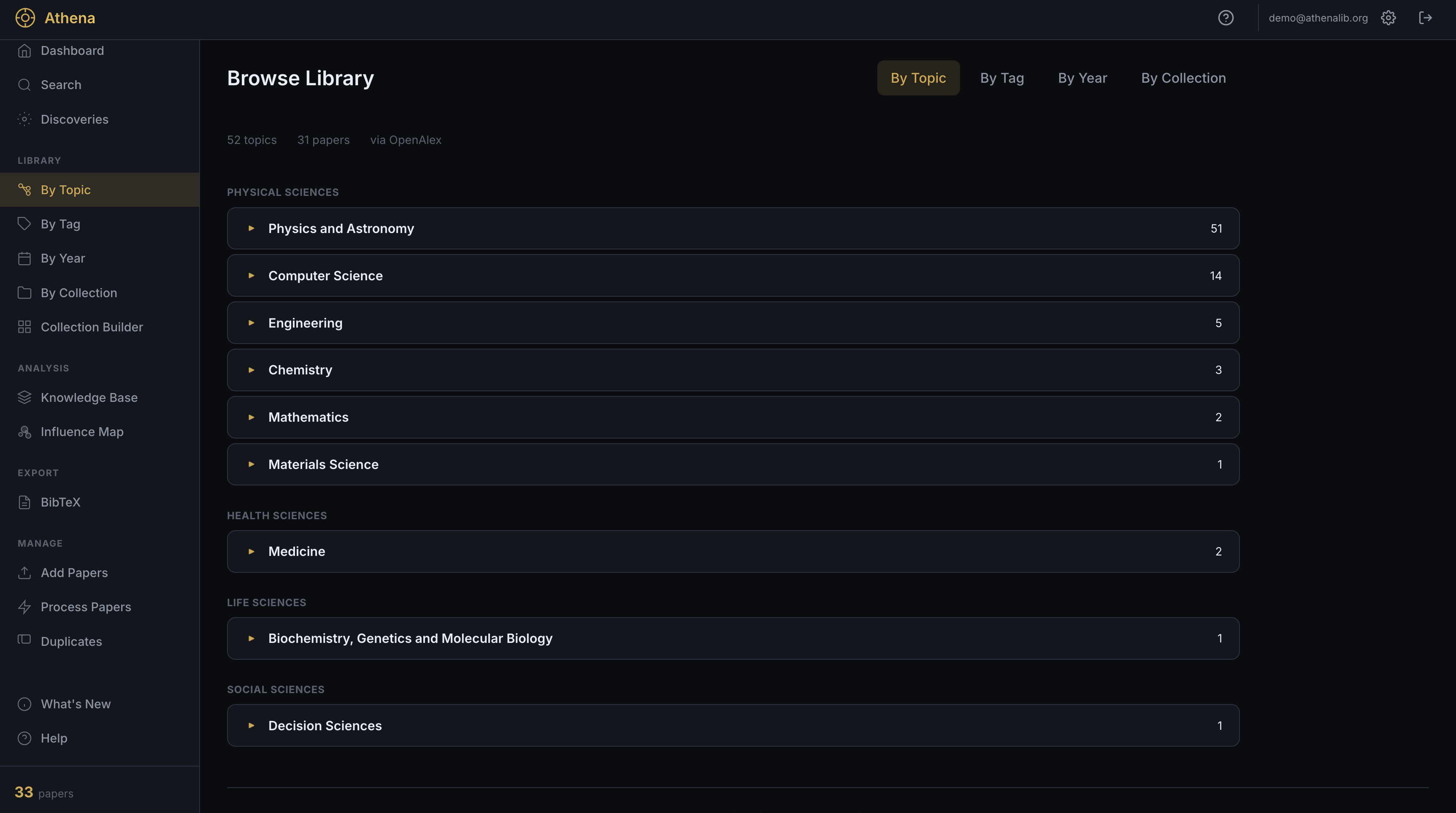
Browse by topic, year, tag, or collection. Search the whole thing instantly. Everything in one place.
Upload a PDF with nothing known about it. Get back a fully cataloged entry — title, authors, journal, year, abstract, citations — resolved automatically from the major scholarly databases like OpenAlex, Crossref, and Semantic Scholar.
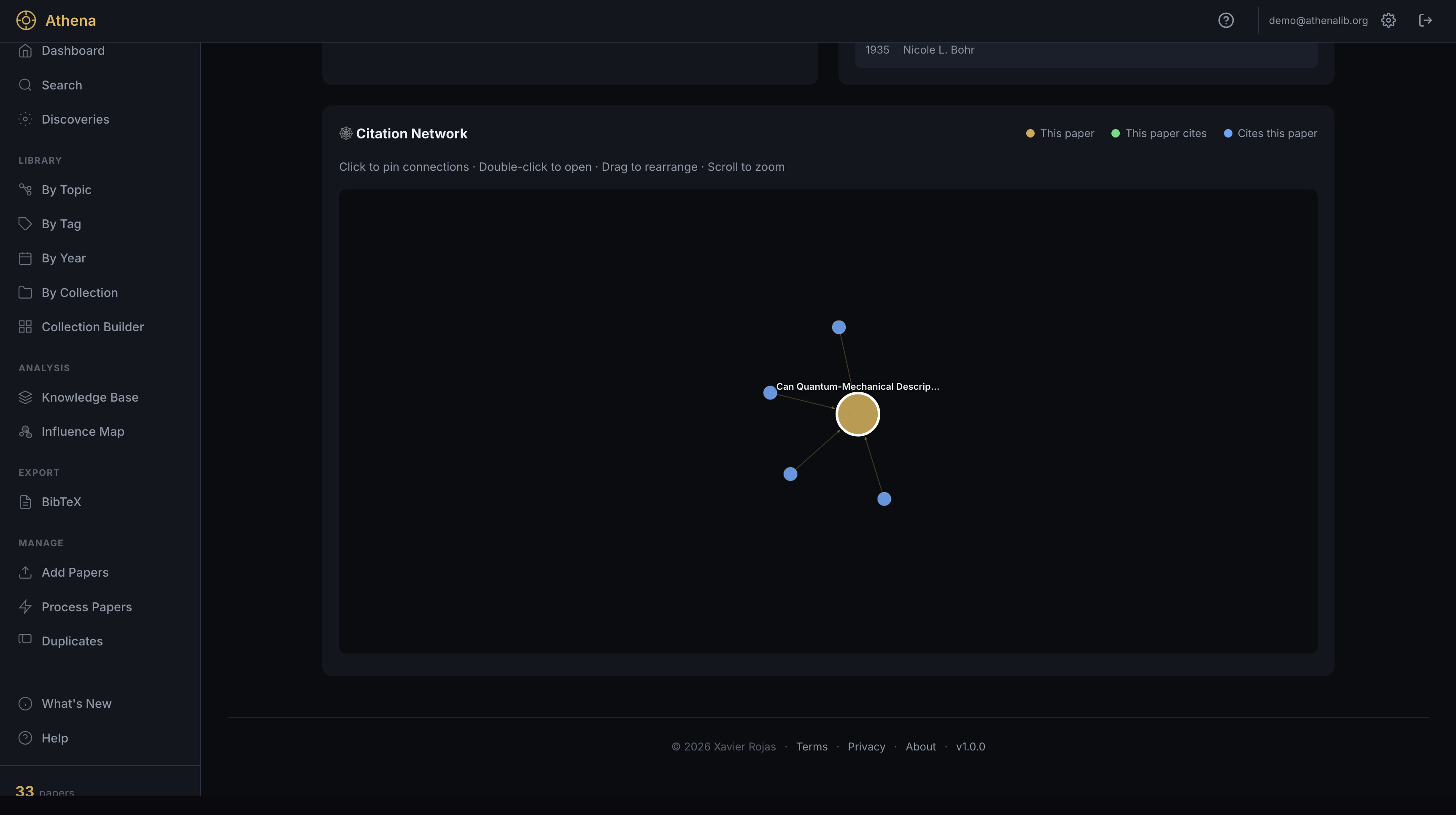
Athena matches references across your entire library, showing which of your papers cite each other and where the connections lie.
Papers you don't own but are cited by papers you do. Discover what's missing from your reading through your own references.
Find papers related to an idea even when they use completely different terminology. Meaning-based search alongside full-text.
Every paper gets categorized — topics, methods, applications — so you can see the shape of your field through your own collection.
Athena watches your field and surfaces newly published papers that match your library — so you keep up with what's relevant without hunting for it.
Why Athena
Built for researchers who accumulate hundreds of papers and need them to stay useful, not just stored.
Your library is a single SQLite file. Download it anytime. No proprietary formats, no hostage data.
Export your papers, metadata, and citations as BibTeX, RIS, or CSL-JSON whenever you want. If you leave, you take everything.
Every feature exists because a researcher needed it. No social feeds, no engagement metrics, nothing that serves the platform instead of you.
Pricing
Athena is currently free for early users. Pricing will be announced when the product is ready for general availability.
Questions
Reference managers store your papers and format citations. Athena reads what you collect — extracting structure, mapping citations, tagging topics, and building semantic connections. The goal is understanding, not just storage.
Yes. Upload PDFs one at a time or in bulk, paste DOIs, or import a BibTeX file exported from any reference manager.
On our servers during early access. Your library is a standard SQLite file — you can download it anytime and take everything with you.
Free during early access. Pricing will be announced when the product is ready for general availability.
Your papers and metadata are isolated in your own database. Nothing is shared between users.
Yes, where it helps — semantic search, automatic topic tagging, and method/theme extraction. Never to generate content you didn't ask for.